🏆 Amazon PPC Experts Delivering Measurable Growth · Revenue-Focused Campaigns →
Here’s an uncomfortable truth about selling on Amazon: if shoppers can’t find your product, nothing else you do matters. Not the quality of the product, not the packaging, not the clever ad copy. A product that sits on page six of the results is, for practical purposes, invisible.
That’s the problem our Amazon SEO services exist to solve. We help sellers and brands rank higher in Amazon search, earn more organic traffic and turn that traffic into sales, through careful keyword research, listing optimization, indexing checks, rank tracking and ongoing testing. No tricks, no black-hat shortcuts that put your account at risk. Just a clear, measurable Amazon SEO strategy built around how Amazon’s search actually works.
As an Amazon SEO agency that also runs Amazon PPC campaigns , we see something most pure SEO providers never get to see: which keywords really convert, what shoppers type right before they buy and how organic rank and paid placement feed each other. That insight goes straight into your Amazon SEO plan.
Start with a free Amazon SEO audit. We’ll show you where your listings rank today, which keywords you’re missing and what to fix first.
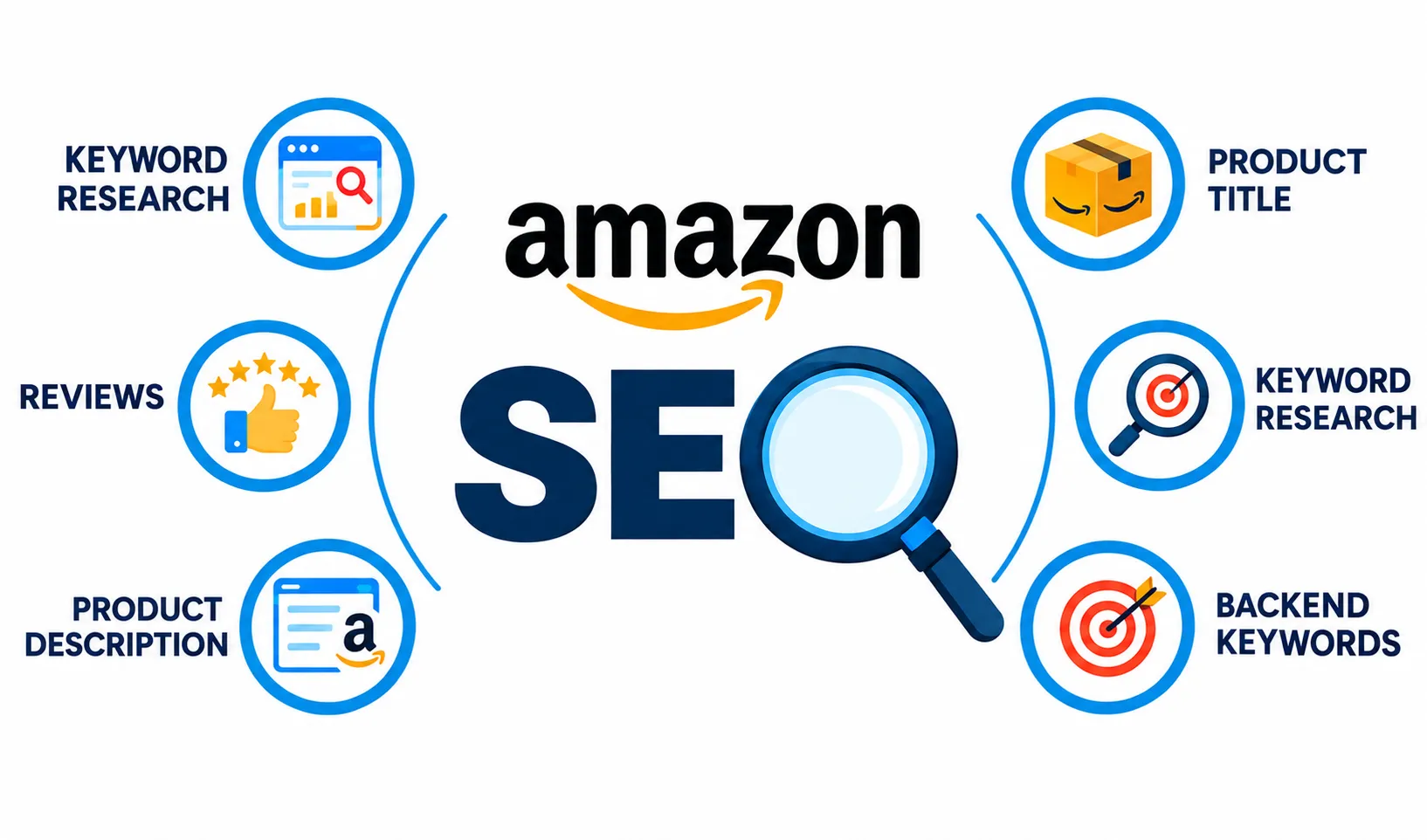
Amazon SEO (Amazon search engine optimization) is the practice of improving your product listings and brand presence so your products rank higher in Amazon’s search results for the keywords your customers use. The goal is more visibility, more organic traffic and more sales without paying for every click.
In plain terms: when someone types “wireless earbuds for running” into the Amazon search bar, Amazon has to decide which of thousands of products to show, and in what order. Amazon SEO is the work of making sure your product is among the ones chosen, and near the top.
Amazon’s search system is often called A9, and some people refer to the newer version as A10. Amazon doesn’t publish how it works, so those names are shorthand for “whatever Amazon uses to rank products.” What we do know, from Amazon’s own guidance and years of testing across thousands of listings, is enough to build a reliable strategy.
Good Amazon SEO is broader than most people expect. It covers:
Measurement: reporting, testing and continuous improvement
If an agency tells you Amazon SEO is mainly about stuffing more keywords into your title, run. Keywords are the entry ticket, but ranking is a performance contest. Amazon wants to show products that match the search and that shoppers actually buy and are happy with. So we work on both sides: relevance (the words) and performance (everything that makes a shopper click, buy and stay satisfied).
SEO Elements
Keywords
Better Visibility
If you’ve done website SEO before, you’ll recognize some ideas, but Amazon works differently in important ways.
| Area | Google SEO | Amazon SEO |
|---|---|---|
| Main goal | Rank pages and drive visits | Rank products and drive purchases |
| Shopper intent | Often researching or browsing | Mostly ready to buy |
| Key signals | Content quality, backlinks, authority, technical SEO | Relevance, sales performance, conversion rate, reviews, price, availability |
| Where your content lives | Your own website | Product detail pages inside Amazon's rules |
| Biggest lever | Content and links | Conversion rate and sales velocity |
| Speed of feedback | Weeks to months | Often faster, because sales data is immediate |
| Advertising link | Separate from organic | Tightly connected: ads can influence organic rank through sales |
The biggest difference is the role of sales. On Google, an excellent page can rank without a single sale. On Amazon, sales history is one of the strongest signals there is. That’s why Amazon SEO and conversion rate optimization are inseparable, and why we plan them together.
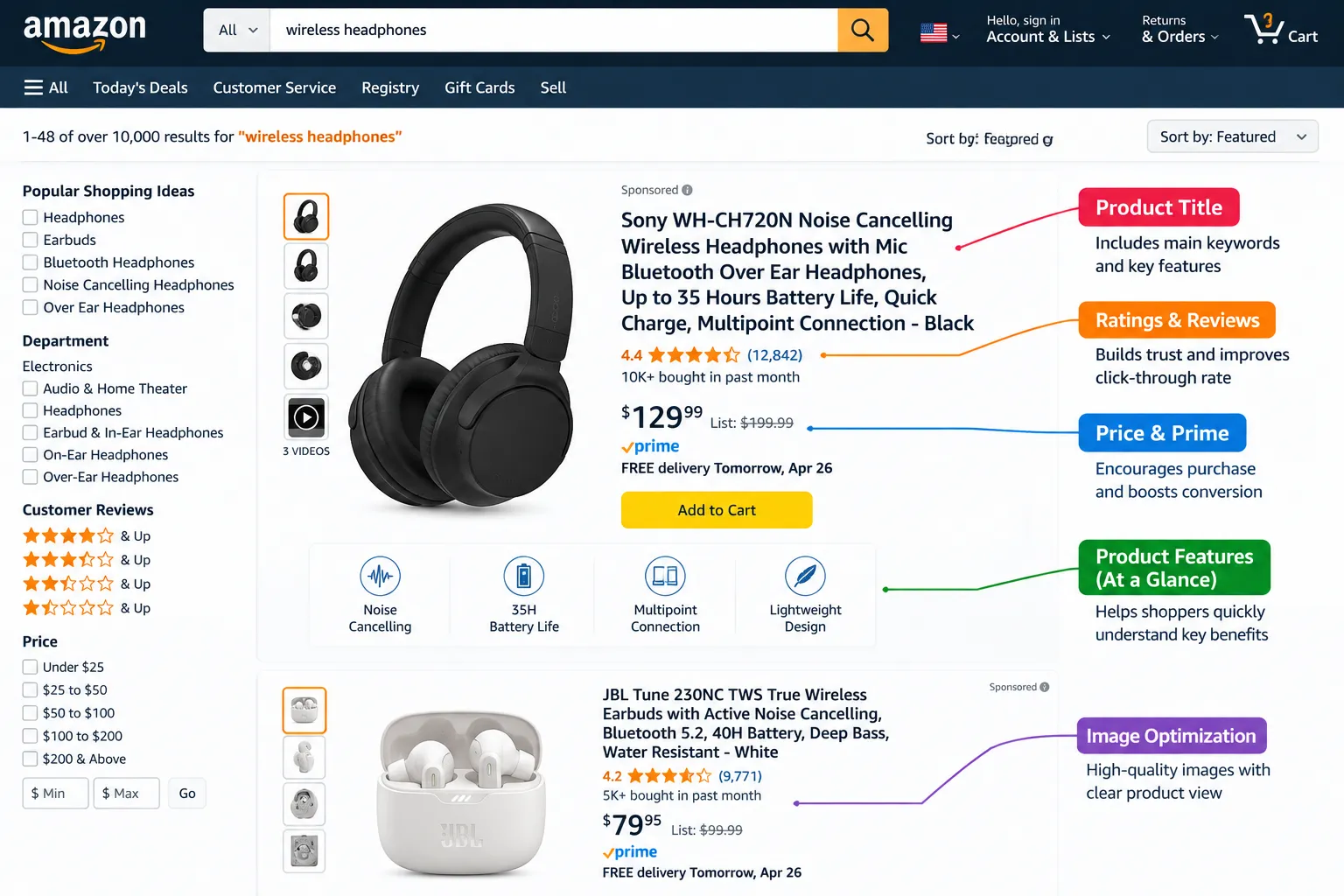
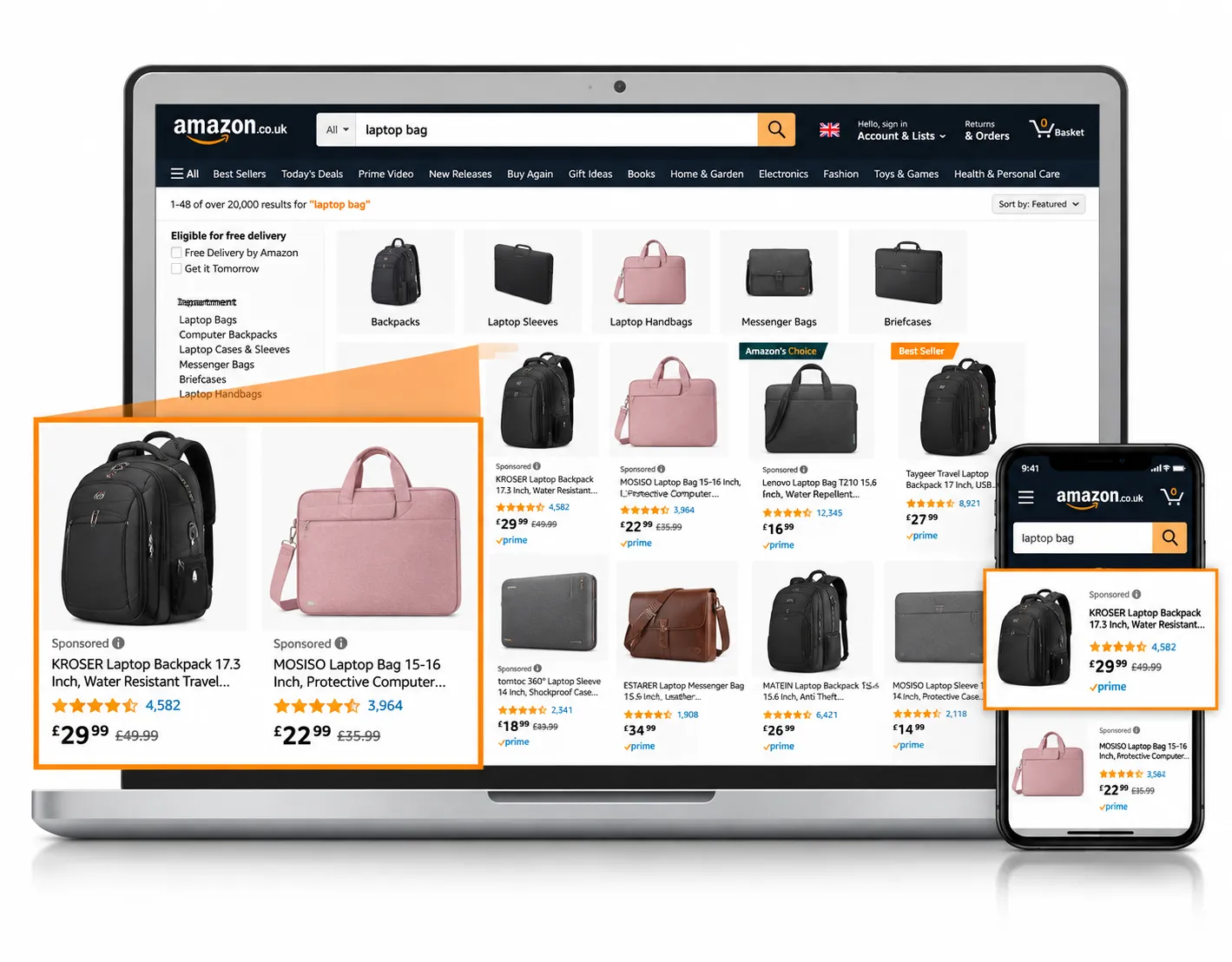
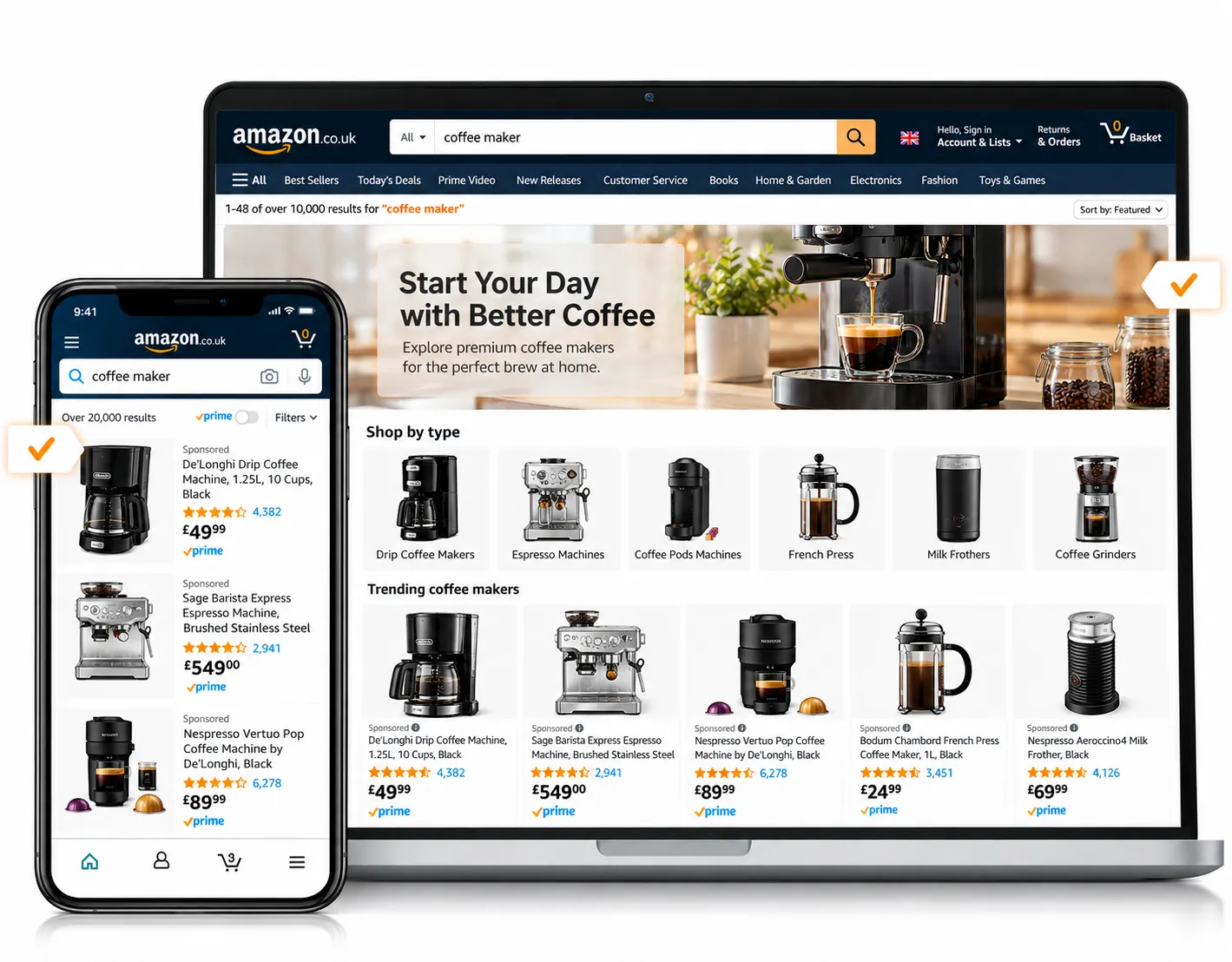
See the difference optimized keywords, content, and listing structure can make for your Amazon product visibility and sales.
You can buy traffic with ads. So why invest in SEO? Because organic visibility behaves very differently from paid visibility.
A large share of Amazon shoppers begin by typing a query into the search bar. If your product doesn't appear for those queries, you're relying on ads, external traffic or luck for every sale.
Organic orders don't come with a per-click fee. A healthy balance of organic and paid sales improves your TACoS (total advertising cost of sales), which is the number that shows how dependent you are on advertising. Brands with strong Amazon SEO can often turn their ad spend down in some periods without losing sales.
When you stop ads, the traffic stops. Organic rank builds on itself: better rank brings more sales, which supports better rank. It's not permanent (competitors fight back), but it's much more durable than rented traffic.
Shoppers trust what ranks highly. If a competitor owns page one for your category keywords, they get the first impression and the default credibility. Strong Amazon SEO protects your position.
A well-optimized listing converts social, email, creator and website traffic better, too. The same improvements that help you rank also help you sell.
Nobody outside Amazon knows the exact formula, and we’d be suspicious of anyone who claims to. But the broad logic is well understood.
Amazon earns when customers buy and come back. So its ranking systems tend to favor products that are relevant to the search, likely to sell and likely to leave customers happy. Everything below is a way of predicting that.
When a shopper searches, Amazon first finds products that could match. It reads your title, bullet points, description, backend search terms, attributes and category placement to understand what your product is. If a keyword isn’t connected to your listing in any way, you generally won’t appear for it. This stage is where indexing happens.
Of the matching products, Amazon decides the order. It looks at how products have performed for that kind of search: click-through rate, conversion rate, sales velocity, price, availability, delivery speed, reviews, returns and more. Products that perform well for a keyword tend to rise for it.
Results can vary by shopper, device, location, past behavior and time of year. That’s why a single “rank number” is always a little fuzzy, and why we track trends rather than obsess over one reading.
Being indexed for a keyword means Amazon associates your product with that search. Ranking well means appearing near the top. Many listings are indexed for hundreds of terms and rank well for almost none. Amazon SEO first makes sure you’re indexed for the right terms, then builds the performance that moves you up.
Amazon has added AI shopping features such as Rufus, which lets shoppers ask questions in natural language, and it has published research on how its systems infer intent (for example, connecting “winter camping” with gear that suits it). The practical takeaway for Amazon SEO in 2026: listings need clear, complete, accurate information about who a product is for, what it does, what it’s made of and how it compares. We cover that in our work, and in a section below.
Think of ranking factors in three groups: what’s on your listing, how shoppers respond to it and what you do outside Amazon.
Every account is different, so we scope the work around your products, category and goals. Here’s the full menu of our Amazon SEO service. Your package will include the pieces that make sense for you.
Everything starts with an honest look at where you are. We review your listings the way both Amazon and a shopper would: keyword coverage, indexing, title, bullets, backend terms, attributes, images, A+ Content, variations, pricing, reviews and compliance. We also look at your performance data (Business Reports, Brand Analytics, search term reports, ad data) to see how each listing performs against its keywords.
You get a clear summary: what’s working, what’s broken, which keywords you’re missing, which competitors are ahead of you and what we’d fix first, in order of impact. No jargon, no 80-page PDF nobody reads.
This is the foundation of every Amazon SEO strategy. We research the keywords your customers actually use, not just the ones with the biggest numbers. That includes head terms, long-tail phrases, feature and use-case queries, problem-based queries, gift and seasonal searches, and misspellings and synonyms.
We use several data sources rather than relying on one tool: Brand Analytics (if you’re Brand Registered), Search Query Performance data, your PPC search term reports, competitor listings, autocomplete suggestions and leading keyword research tools. Every keyword is scored for relevance, volume, competition and conversion potential, then grouped by intent and assigned a home in your listing.

You don’t rank in a vacuum. We study the top competitors for your main keywords to see which terms they’re indexed and ranking for, how they position their products, what their images and A+ Content emphasize, what their reviews praise and complain about, and where they’re weak. A reverse ASIN search often turns up keyword opportunities that you’d never find on your own.
The point isn’t to copy. It’s to find the gaps they’ve missed and the angles you can own.
A good Amazon title is readable first and keyword-rich second. We put the most valuable keywords early, in natural order, include the attributes shoppers filter by (size, count, material, compatibility) and keep the mobile view in mind. We follow your category’s current style rules, and we never stuff.
Bullets and descriptions carry your secondary and long-tail keywords, and more importantly they persuade. We write benefit-led bullets that include supporting keywords naturally, answer objections and make scanning easy. The description (or A+ Content) tells the story and adds use-case phrases and context.
The hidden keyword fields are valuable but tightly limited, so each byte has to earn its place. We use them for synonyms, abbreviations, alternate spellings, related terms and relevant foreign-language terms, without repeating words that already appear in your visible copy and without competitor brand names or policy violations.
Amazon relies on structured data more every year. We complete and correct the attributes for your category (material, color, size, target audience, special features and so on) and confirm each ASIN sits in the right browse node. Wrong or missing data can hold back a listing in filters, refinements and AI-driven results, which makes this some of the most overlooked Amazon SEO work.
Your main image drives click-through rate, which feeds ranking. Your gallery drives conversion, which also feeds ranking. We check main image compliance, plan alternative main images for testing, and design the gallery as a short sales conversation: use, scale, features, comparison, what’s in the box and proof. Where possible we make image text readable at mobile size and add accessible descriptions.
A+ Content isn’t just decoration. It’s one of the best conversion levers you have, and it adds context for shoppers and for modern search features. We plan the modules, write the copy, include comparison charts and FAQ blocks, and write alt text for each image. For Brand Registered sellers, we also set up Brand Story. (A+ Content and Brand Story need Brand Registry.)
A well-structured Brand Store gives shoppers a home for your range and gives you a landing page for ads, social and email. We help with navigation, product groupings, page titles and descriptions, and imagery that supports both sales and discovery.
Variation families consolidate reviews and sales history, which strengthens rank for every child ASIN. We check your parent-child structure, themes and naming, correct category placement, fix catalog errors and identify where merging listings (where policy allows) would help.
Reviews affect both ranking and conversion. We don’t buy or incentivize reviews (that gets accounts suspended). What we do is mine reviews and Q&A for the language customers use, which feeds keyword research and copy; identify recurring complaints that the listing can address honestly; and advise on compliant ways to earn more reviews, such as Amazon’s Request a Review feature and Vine for eligible products.
These aren’t “SEO” in the strictest sense, but they affect rank so strongly that we’d be doing you a disservice to ignore them. We flag price positioning against competitors, stock-out risks, inventory performance issues and Buy Box problems that undermine your keyword work. Fixing them may sit outside our scope, but you’ll know about them.
Your ads and your SEO share the same keywords and the same shoppers. We use your search term reports to find keywords that convert, feed them into your listing, and use ranking campaigns to support priority terms. Our Amazon PPC management and SEO teams plan together.
Outside traffic can support your sales velocity and brand demand. We help plan landing pages, link structures and campaigns that send qualified shoppers to your Amazon listings, and we make your listings and Brand Store as visible as possible on Google.
Shoppers increasingly ask Amazon full questions: “which cordless vacuum is best for pet hair in a small apartment?” To be recommended, your product information has to be clear and complete. We rewrite listings to state use cases, audiences, materials, dimensions and comparisons plainly, fill every relevant attribute and use A+ Content to answer common questions. No gimmicks, since nobody outside Amazon knows exactly how these systems weigh things. We just make your product easy to understand.
After changes go live, we verify that your priority keywords are indexed and begin tracking rank for your target terms, using a mix of tools and manual spot checks. We report trends, not single-day readings, because Amazon rankings fluctuate.
You receive a clear monthly report: keyword rank movement, indexing status, impressions, CTR, conversion rate, organic versus ad-attributed sales, TACoS, test results and next steps. Plus a call or message where we explain what it means in plain English.
So you know what you’re paying for, here is the typical set of outputs in an Amazon SEO engagement. Your exact list depends on your package.
Everything we produce for you, from keyword maps to copy to briefs, is yours. If we ever part ways, you keep it and can hand it to anyone. [CONFIRM YOUR IP AND OWNERSHIP TERMS]
Product knowledge, quick feedback on drafts, access to the relevant reports and honest information about your goals, margins and constraints. The more we know about your business, the better the SEO plan.
We don’t buy or incentivize reviews. We don’t use hidden-text tricks, fake traffic or any method that breaks Amazon’s policies. We don’t promise rankings we can’t control. And we don’t keyword-stuff, because it doesn’t work.

We like clients to know what happens, when and why. Here’s how a typical Amazon SEO engagement runs.
We analyze your listings, keywords, competitors and account data, and capture a baseline: current rank for target keywords, indexing status, CTR, conversion rate, organic and ad sales, ACoS and TACoS. Without a baseline, you can’t prove progress.
We build the keyword map, choose priority ASINs and keywords, and write a prioritized plan: which listings to fix first, which keywords to target in the title, what to test and how SEO and PPC will work together.
We write and apply the optimizations: titles, bullets, descriptions, backend terms, attributes, image briefs, A+ Content and category corrections. You review everything before it goes live, because your product knowledge matters.
We verify indexing, track rank, start A/B tests using Manage Your Experiments, monitor competitors and report every month. What we learn from your best listings gets rolled out across the catalog.
Days 1 to 30: audit, baseline, research and first round of listing updates for your priority ASINs. Expect indexing improvements and early movement in click-through rate.
Days 31 to 60: second round of updates, first A/B tests, PPC alignment and early rank gains for long-tail and mid-volume keywords.
Days 61 to 90: broader rank improvements, test results rolled out, catalog expansion plan and a review against the baseline.
Bigger, more competitive keywords usually take longer than 90 days. Anyone promising number-one rank for a competitive head term in a few weeks is selling you a story.

Tools help, but they’re not the strategy. They’re inputs we check against each other and against real data from your account.
No tool is perfect, since estimates of search volume are just that. That’s why we cross-check.
It’s tempting to treat Amazon SEO as a hack for a quick bump. The sellers who do best treat it as part of building a brand customers actually want. That means a product that does what the listing says, content that’s honest and useful, reviews earned the right way and a keyword strategy that follows how real people talk. Rank is the result, not the goal. When shoppers find your product, understand it quickly and are glad they bought it, the signals Amazon watches tend to take care of themselves.
A brand sells a 2-in-1 yoga mat and towel. It sells steadily through ads but has almost no organic sales. In the audit we find the title leads with the brand name and a vague phrase, “premium yoga accessory.” Searching “non slip yoga mat towel” plus the ASIN doesn’t return the product, which means it isn’t indexed for that phrase, although that’s exactly how customers describe it. The fix: a title that leads with the clear product name and key attributes, bullets that use the customer’s language, backend terms for synonyms such as “hot yoga towel” and a gallery that shows the grip in action. Indexing is checked a few days later, rank on long-tail terms starts to move in the weeks that follow and ads begin working harder because the page now matches the searches.
A kitchen gadget held a top-five position for its main keyword for a year, then slowly slid to page two. Nothing changed on the listing. What changed was the market: two competitors launched with strong main images and comparison charts, and their conversion rates were higher. The fix isn’t more keywords in the title. It’s a competitive review, a new main image to test, an A+ comparison chart and a response to the objections competitors’ reviews were raising. Amazon SEO isn’t “set and forget,” and that’s the point of the defense phase.
A pet brand spends heavily on a broad keyword with high volume. Search term data shows that the shoppers who convert actually use more specific phrases such as “slow feeder bowl for small dogs.” The fix is to move those specific phrases into the title and bullets, shift ad budget toward them and reduce spend on the broad term. Organic rank on the specific terms grows, TACoS improves and the brand stops paying for traffic that was never going to buy.
Want to see how you’re doing before you talk to anyone? Score yourself honestly. Every unchecked box is an opportunity.
We’ve reviewed a lot of accounts. These come up constantly.
Cramming the title with every keyword might look like effort, but it hurts readability, click-through rate and sometimes compliance. Write for a person first.
A keyword with huge volume that doesn't fit your product brings the wrong shoppers. Conversion drops and rank follows.
You can't rank for terms Amazon doesn't connect to your listing. Check indexing. Don't assume.
Copying competitors makes you the cheaper version of someone else. Learn from them, then differentiate.
It's your biggest click-through lever. A dull or non-compliant main image undermines everything else.
Those structured fields feed filters, refinements and AI-driven features. Complete them.
Repeating words, adding commas and punctuation, or leaving the field half-empty are all common mistakes. Use every byte on purpose.
Your ads and your organic strategy share keywords and shoppers. Plan them together.
If you change the title, images, price and bullets in the same week, you'll never learn what worked. Change in a sensible order and test the big stuff.
It violates Amazon's rules, and suspension can erase years of work. Not worth it.
Search behavior shifts, competitors adapt and Amazon changes. Review rank and listings regularly.
Out-of-stock periods, bad pricing or a poor rating can sink great keyword work. Look at the whole picture.
Relevance matters, but a title stuffed with keywords hurts clicks and conversion, which hurts rank.
They’re useful, but limited. They fill gaps. They don’t replace good visible copy.
Rankings shift constantly. The best listings are monitored, tested and refreshed.
Ads don’t directly “buy” rank, but sales driven by ads count as sales. Well-targeted ads can support organic performance for priority keywords.
No one controls Amazon’s results. Be wary of anyone who says otherwise.
They influence conversion and shopper trust, and conversion influences ranking. They matter a great deal.
Backlinks and blog content are great for websites, but Amazon’s ranking depends mostly on relevance and sales performance.
They’re estimates. Use them for relative comparison and cross-check with Amazon’s own data.
Rank without conversion is a vanity metric. Profit and sales are what pay the bills.
If anything, clear, complete product information matters more, since AI features rely on it to understand what you sell.
If you own a brand, Brand Registry gives you tools that non-registered sellers don’t have. Many brands only use a fraction of them.
We set up a routine around these tools: a monthly look at Brand Analytics for new keyword opportunities, a review of Search Query Performance to find where shoppers drop off and a testing calendar for Manage Your Experiments. Not Brand Registered yet? We’ll tell you what to do now and help you plan for it.
Amazon SEO services help your products rank higher in Amazon search results through keyword research, listing optimization (titles, bullets, descriptions, backend terms and attributes), image and A+ Content improvements, indexing checks, rank tracking and testing. The aim is more organic visibility, more traffic and more sales with less reliance on paid ads.
An Amazon SEO agency audits your listings, researches keywords, studies competitors, rewrites and optimizes your content, verifies indexing, tracks rank, runs tests and reports on results. A good one also connects SEO with your advertising so both work together.
Costs depend on the number of ASINs, category competitiveness, scope (audit, rewrite, creative, ongoing support) and whether you want a one-time project or a monthly retainer. A free audit is the quickest way to get a realistic quote.
Indexing and click-through improvements can appear within days or a few weeks of updating a listing. Rank gains for long-tail keywords commonly build over one to three months, and competitive keywords can take longer. Results vary with category, competition, price, reviews and stock, so we measure against a baseline rather than promise a fixed timeline.
No, and be cautious of anyone who does. Amazon controls its rankings, and they depend on relevance, sales performance, reviews, price, availability and competition. What we can do is improve every factor within your control, measure progress and report honestly.
Amazon SEO improves your organic (unpaid) visibility. Amazon PPC pays for ad placement. They work best together: PPC data shows which keywords convert, SEO makes your listing convert better, and sales from ads can support organic rank. Learn more about our Amazon PPC services
Amazon SEO focuses on visibility: keywords, indexing, ranking and the performance signals behind them. Listing optimization covers the content itself (copy, images, A+ Content) and its power to persuade. In practice they overlap and you need both.
No. Google SEO ranks web pages and relies heavily on content and links. Amazon SEO ranks products and relies heavily on relevance and sales performance, including conversion rate, reviews, price and availability. Some off-Amazon work (Google visibility for listings, external traffic) overlaps with website SEO.
Relevance (title, bullets, backend terms, attributes, category) and performance (click-through rate, conversion rate, sales velocity, reviews, price, availability and returns). Amazon doesn't publish exact weights, so treat any claim of a precise formula with suspicion.
Combine several sources: Brand Analytics and Search Query Performance (if you're Brand Registered), your PPC search term reports, competitor listings, reverse ASIN searches, autocomplete and research tools such as Helium 10 or Jungle Scout. Filter for relevance before volume, group keywords by intent and assign each a place in the listing.
A common check is to search for the keyword together with your ASIN on Amazon. If your product appears, it's indexed for that term. If it doesn't, the keyword isn't connected to your listing, and you'll want to add it in a natural, policy-compliant way. Tools can also help check indexing in bulk.
Amazon has historically allowed roughly 250 bytes of backend search terms, with no repeated words, no commas required and no competitor brand names. The limit and rules can change by marketplace and category, so we check the current rules in Seller Central. Bytes aren't the same as characters, since some non-English characters use more than one byte.
Ads don't directly buy rank, but sales from ads count as sales, and sales performance for a keyword is a strong signal. Well-targeted campaigns on priority keywords can support organic performance. Poorly targeted ones simply spend money.
Indirectly, but strongly. Reviews and ratings affect shopper trust, click-through rate and conversion, which in turn affect ranking. We never buy or incentivize reviews. We help you earn them in compliant ways.
We write and structure listings so that who the product is for, what it does, what it's made of, its size and how it compares are clear, accurate and complete across the title, bullets, description, A+ Content and attributes. Nobody outside Amazon knows exactly how its AI features weigh information, so we avoid gimmicks and focus on clarity.
You can do a lot without it: keyword research, title, bullets, backend terms, images, attributes and variations. But Brand Registry unlocks Brand Analytics, A+ Content, Brand Story, Manage Your Experiments and brand protection, all of which help. If you're not enrolled, we can help you plan for it.
Yes. We adapt keyword research and listings for each market, since search terms, spelling and units differ.
Yes. We diagnose the cause (missing keywords, wrong category, suppressed listing, poor conversion or competitive pressure), fix what's fixable and recommend next steps for what isn't. If the issue involves your account rather than the listing, we'll say so plainly.
Review priority listings at least once a quarter and track rank monthly. Update sooner if rank or conversion drops, a new competitor arrives, your product changes or a peak season approaches.
Amazon's own data (Brand Analytics, Search Query Performance, Business Reports, search term reports) combined with research and tracking tools such as Helium 10, Jungle Scout, Data Dive and Keepa, plus Google tools for off-Amazon work. Tools provide estimates, so we cross-check them against real account data.
No. We study competitors to find gaps and positioning angles, but we write original content. Copying produces weaker listings and can create policy and legal problems.
Your ASINs or listing links, your goals and ideally access to (or exports from) Business Reports, ad data and Brand Analytics. Product details, brand guidelines and existing creative help too. We keep your data confidential.
We measure against a baseline, so conversations are about real numbers. If something isn't working, we'll tell you what we think is happening and what we'd change.