🏆 Amazon PPC Experts Delivering Measurable Growth · Revenue-Focused Campaigns →
Amazon advertising can be the quickest way to grow a brand on Amazon. It can also be the quickest way to give your margin away. The difference rarely comes down to one big mistake. It comes down to hundreds of small decisions made, or not made, every week inside your Amazon Ads account.
Amazon PPC Expert is a specialist Amazon advertising team with more than 10 years of hands-on experience. We manage Sponsored Products, Sponsored Brands, Sponsored Display and Amazon DSP for sellers and brands across international Amazon marketplaces, and we judge every campaign the way you do: by profit, total sales and long-term growth.
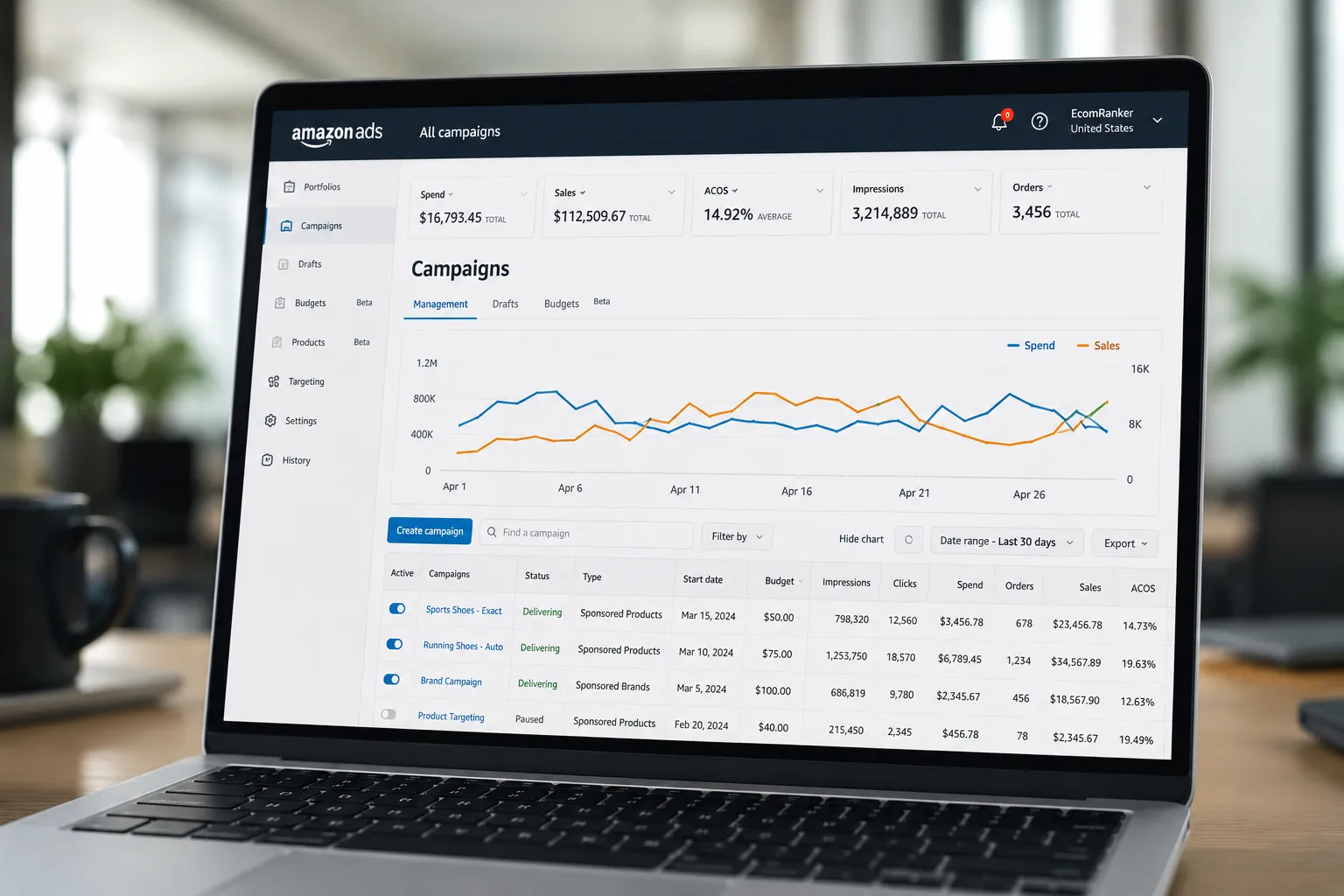
Amazon PPC management is the ongoing work of planning, building, monitoring and optimising pay-per-click advertising on Amazon. It covers Sponsored Products, Sponsored Brands, Sponsored Brands Video and Sponsored Display, and for larger brands, Amazon DSP.
Good management combines three things:
The goal is not more clicks or even a lower ACoS for its own sake. It is more profitable sales and stronger organic visibility, at an advertising cost your margins can support.
Amazon’s ad auction never stands still. Competitors raise and lower bids daily. Seasonal peaks such as Prime Day and the run-up to Christmas change both demand and cost per click. New sellers enter your category. Amazon adds new placements, bidding options and ad formats.
Campaigns that were profitable six months ago can drift into waste without anyone noticing. The usual signs are familiar:
None of these are dramatic on their own. Together, they are why so many sellers feel Amazon advertising is a cost they can’t control. Active Amazon PPC management turns it back into a lever you can pull with confidence.
Average Increase in PPC-Driven Sales
Average Reduction in Wasted Ad Spend
Average Improvement in ROAS
Amazon PPC Campaigns Managed
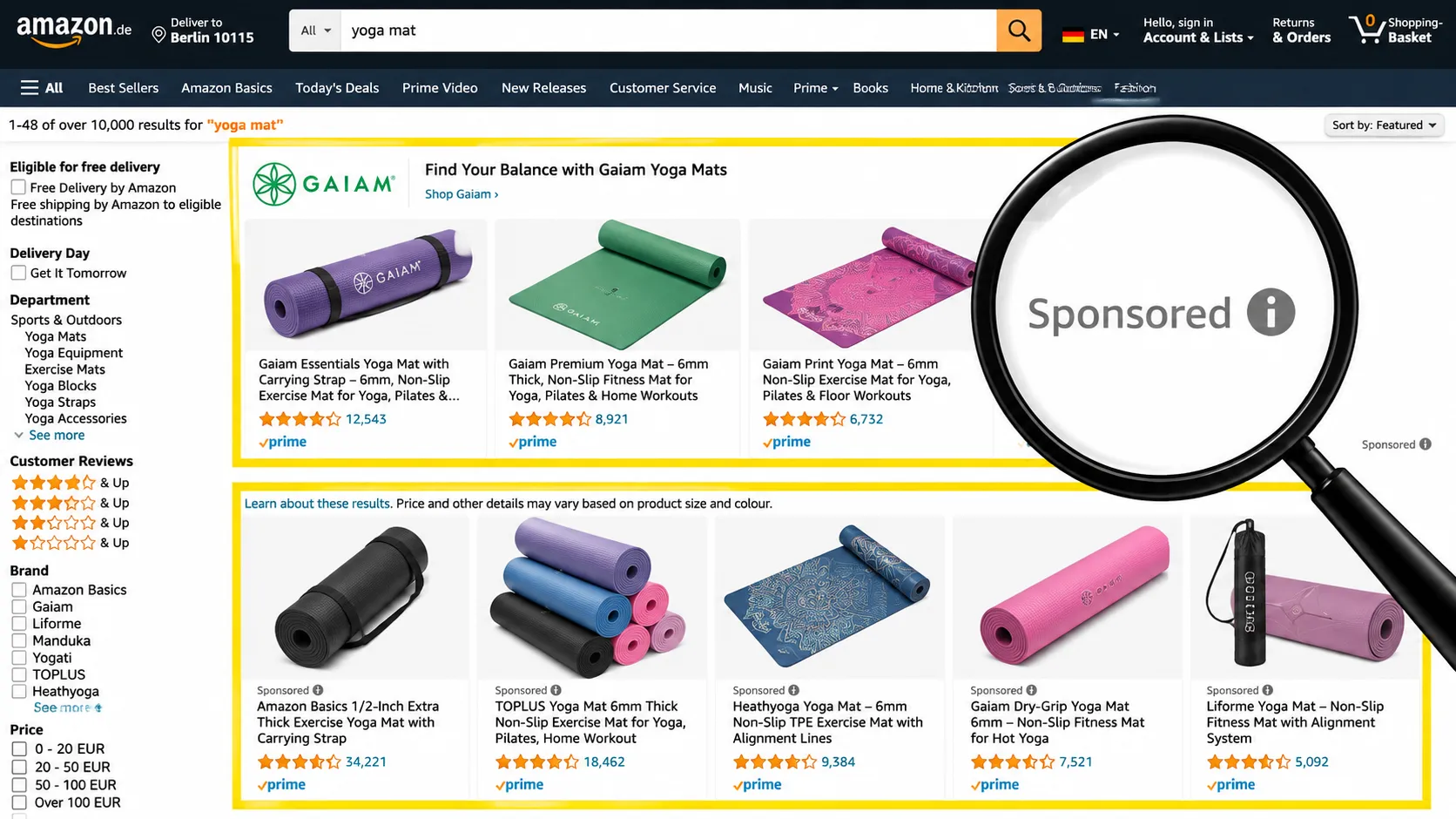
Hiring a specialist Amazon PPC agency isn’t about handing over a job you could do yourself. It’s about getting experience you would otherwise pay for through trial and error, using your own ad budget.
What professional management brings:
Advertising performance depends on more than bids. Listing quality, organic rank, creative and stock levels all affect what each click is worth. That’s why we look at the whole picture, connecting PPC with Amazon SEO, listing improvements and creative, so paid and organic growth support each other rather than working in separate silos.






If you run campaigns yourself, these are the fundamentals we apply to every account. Use them as a checklist. If you’d rather hand the work to specialists, our free audit applies all eight to your account.
Before spending anything, calculate break-even ACoS for each product. Take the selling price, subtract product cost, Amazon referral and fulfilment fees, and any shipping or storage costs. Divide what’s left by the selling price. That percentage is the most you can spend on ads per sale before losing money.
Then decide what you want from each product. A launch might accept an ACoS above break-even for a few months to gain reviews and rank. A mature bestseller should usually run well below it. Without these targets, there’s no way to judge whether a campaign is working.
Action: list your top products with their margin, break-even ACoS and a target ACoS. Add an overall TACoS goal for the account.
The best Amazon keywords come from how real shoppers search, not from how you describe your product internally. Look at Amazon’s search bar suggestions, competitors’ titles and bullet points, your Brand Analytics search terms if you have Brand Registry, and most importantly, your own search term reports.
Group keywords by intent. A shopper typing a broad category term is browsing. A shopper typing size, material, use case and quantity is close to buying, and usually converts better at a lower cost per click.
Action: build a keyword list grouped into branded, high-intent long-tail, broad category and competitor terms.
One campaign holding every keyword and match type is the most common problem we find in audits. It makes budgets uncontrollable and data impossible to read.
A cleaner structure gives each campaign one job:
Action: split mixed campaigns by match type and intent, carrying over keywords that already convert.
A sensible starting bid comes from three numbers: your target ACoS, your average order value and your conversion rate. Multiply them together and you have the most you can pay per click while staying on target.
Choose bidding strategies deliberately. Dynamic bids down only is a safer default. Dynamic bids up and down can work well on proven exact-match terms. Fixed bids give the most control when testing.
Action: calculate a target CPC for your top products and compare it with what you are actually paying.
Your search term report shows the exact searches that triggered your ads. It is the single most valuable report in Amazon Ads.
When a search term converts well, add it as an exact-match keyword in its own campaign and give it its own bid. When a term spends without converting after a fair number of clicks, add it as a negative exact or negative phrase. Base negatives on data, though: adding too many too early cuts off the discovery that finds new customers.
Action: review the last 30–60 days of search terms, sorted by spend, every week or two.
Amazon shows ads at top of search, rest of search and on product pages, and each often converts at a different rate. Your placement report shows the difference.
If top of search converts much better, a placement bid adjustment can win more of that traffic. If product pages waste money, lower the base bid rather than paying a premium everywhere.
Action: compare ACoS and conversion rate by placement for your top campaigns.
Advertising sends shoppers to your listing. It can’t make them buy. If a product gets plenty of clicks but few orders, raising bids only buys more of the same problem.
Check the main image, title, price, reviews, bullet points and A+ Content first. A small lift in conversion rate lowers ACoS across every campaign at once.
Action: list any advertised product with a conversion rate well below your account average, and review its listing before increasing spend.
Amazon PPC rewards consistency more than big one-off changes. A simple routine works:
Avoid reacting to a few days of data. Amazon credits sales to ads over an attribution window, so recent results often improve once late orders are counted.
Action: put a recurring review in your calendar, and stick to it.
Most underperforming accounts don’t fail because of one big error. They leak money through several small ones. These are the issues we see most often in Amazon PPC audits:
If several of these sound familiar, a [free Amazon PPC audit] will show how much each is costing you.
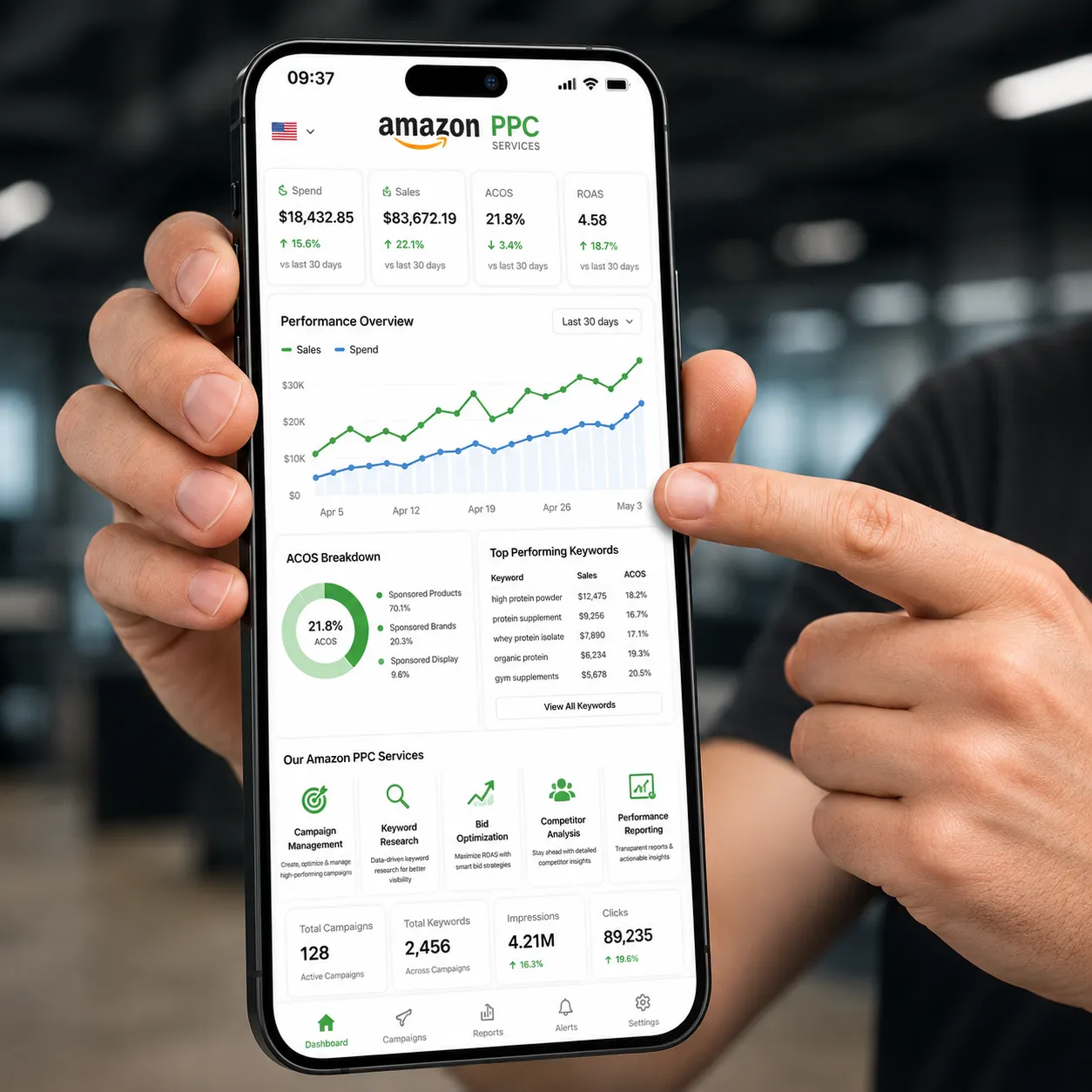
Everything needed to run Amazon advertising properly, handled by one specialist team.
We review your campaigns, search terms, spend and sales alongside product margins, then set a break-even ACoS, target ACoS and TACoS goal so every decision has a clear benchmark.
Campaigns are organised by intent and match type: discovery, expansion, exact, branded and product targeting. Clean structure produces clean data, and clean data produces better decisions.
We research how shoppers search for your products and which competitor and complementary ASINs to target, refining category targets by brand, price and star rating.
Bids are set from conversion rate, cost per click and margin. Budgets move towards the campaigns earning the most profit, so strong performers don’t run out of budget early in the day.
Converting terms move into exact-match campaigns with their own bids. Wasteful terms become negatives, added on evidence so discovery isn’t choked off.
We compare top of search, rest of search and product page performance, and apply placement adjustments only where the numbers justify paying more.
We manage headline, video and Store-led Sponsored Brands campaigns and Sponsored Display retargeting and defence, working with our Amazon creative design team when new assets are needed.
We watch who is bidding on your branded terms and product pages, how category CPCs are moving and where competitors leave gaps you can win.
Regular, plain-language reports cover spend, sales, ACoS, TACoS and ROAS, plus what we changed and why.
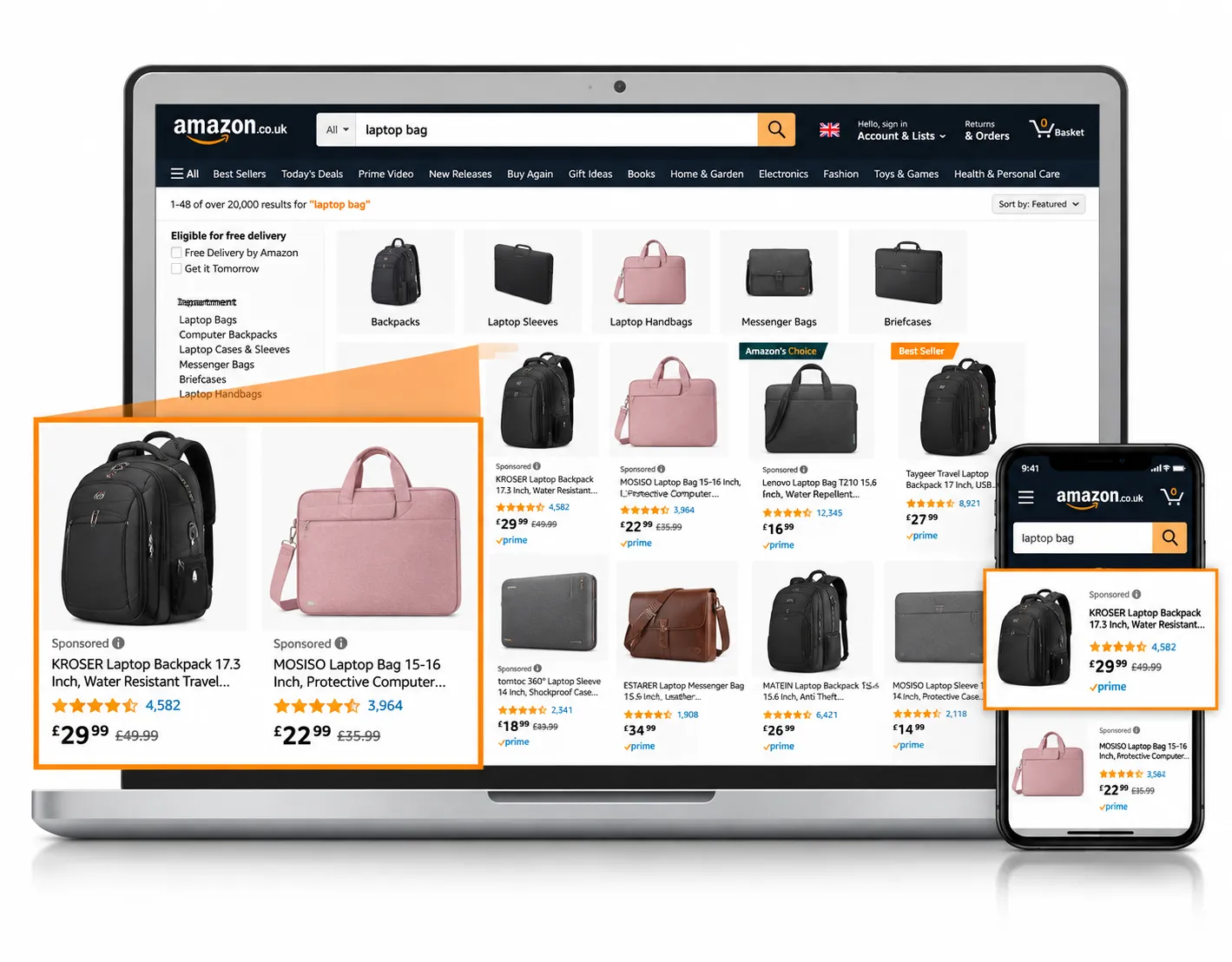
Sponsored Products promote individual listings in search results and on product pages. For most sellers they carry the largest share of spend and sales, which is why they get the most attention: keyword and product targeting, auto targeting groups, match types, bids, placements and search term harvesting.
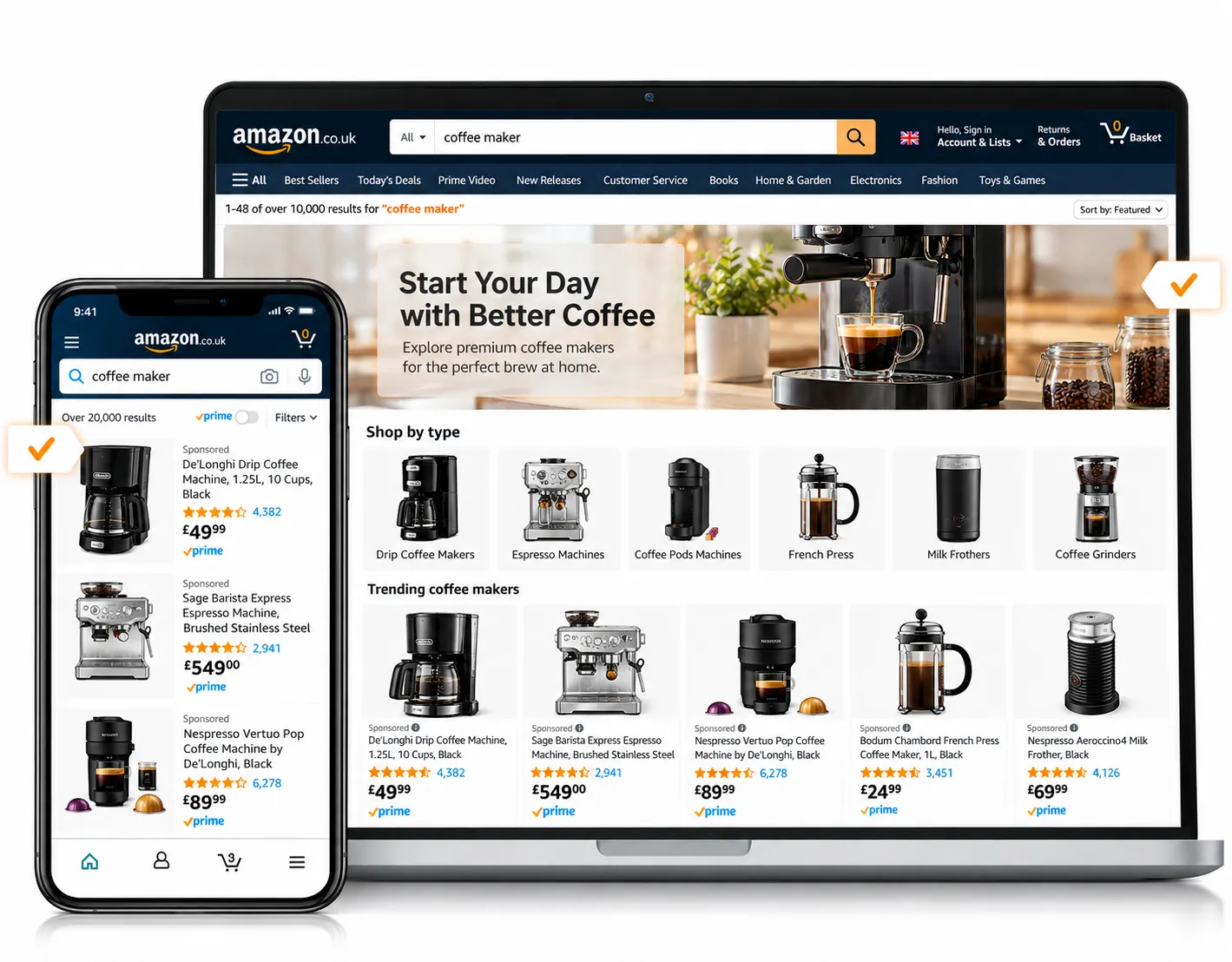
Available to brands enrolled in Amazon Brand Registry, Sponsored Brands show your logo, a custom headline and several products, or link to your Amazon Store. We use them to win branded and category searches and to introduce shoppers to more of your range.

Video ads autoplay in search results and often stand out more than static ads. They work especially well for products that are easier to understand in use. We plan targeting around the video and advise on what the first few seconds need to show.

Sponsored Display reaches shoppers by product, category or audience, on and off Amazon, including people who viewed your product but didn’t buy. We use it mainly for retargeting and for defending your own product pages from competitor ads.
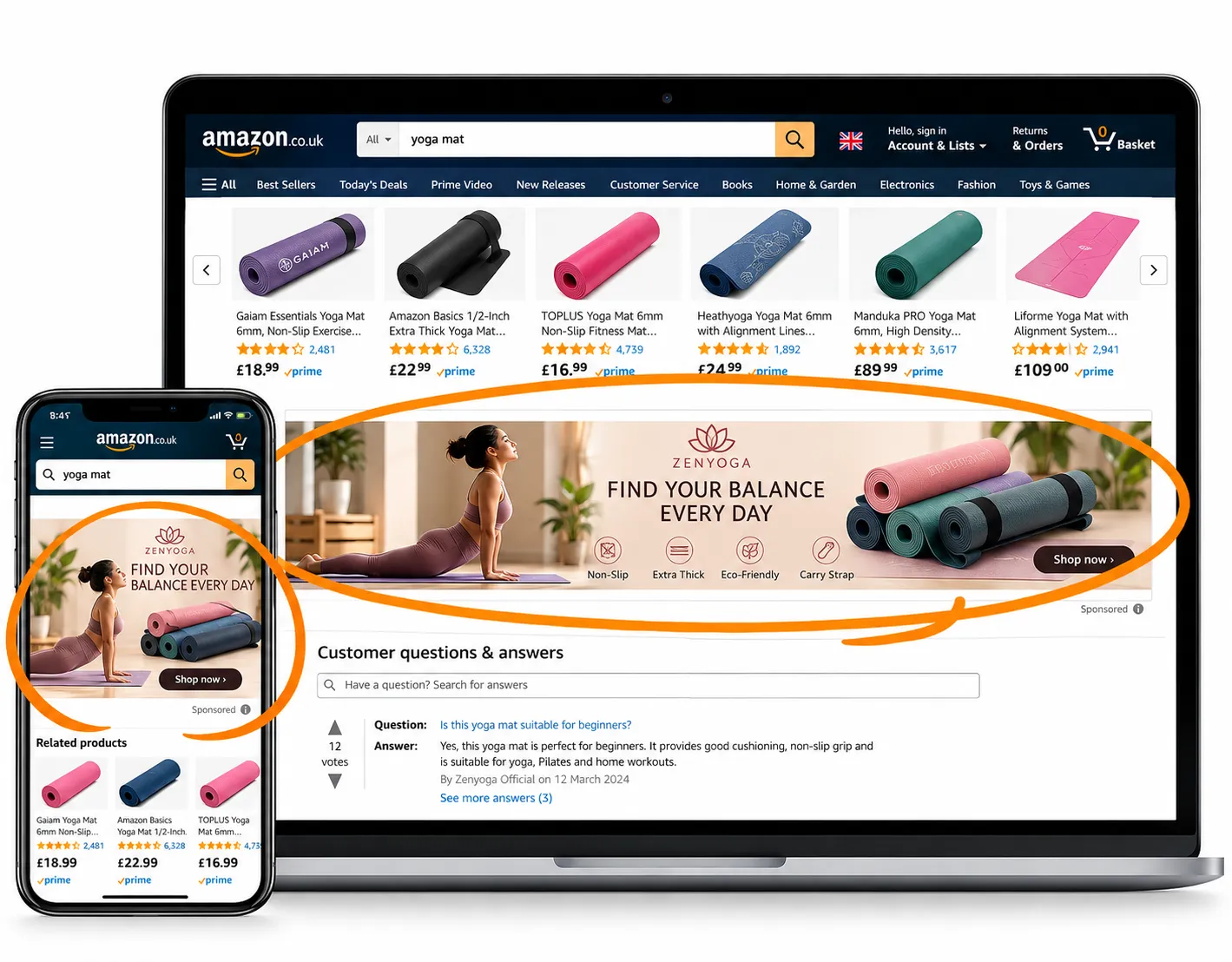
Amazon DSP is Amazon’s programmatic platform for display, video and audio ads on Amazon and across third-party sites and apps. It suits brands with larger budgets that want to reach audiences beyond search. See Amazon DSP advertising management for details.
Good decisions need the right data. Depending on your account and eligibility, we work with:
Amazon now offers dynamic bidding, rule-based bidding, budget rules and AI-generated ad creative, and there are plenty of third-party tools that promise to automate PPC entirely. Used well, automation saves time. Left unchecked, it can raise bids on the wrong terms or spend budget on searches that never convert.
We use automation where it helps, for bulk changes, alerts and reporting, and keep the decisions with experienced people: which search terms to harvest, which to negate, when to scale and when to pull back. Technology handles the volume; specialists handle the judgement.
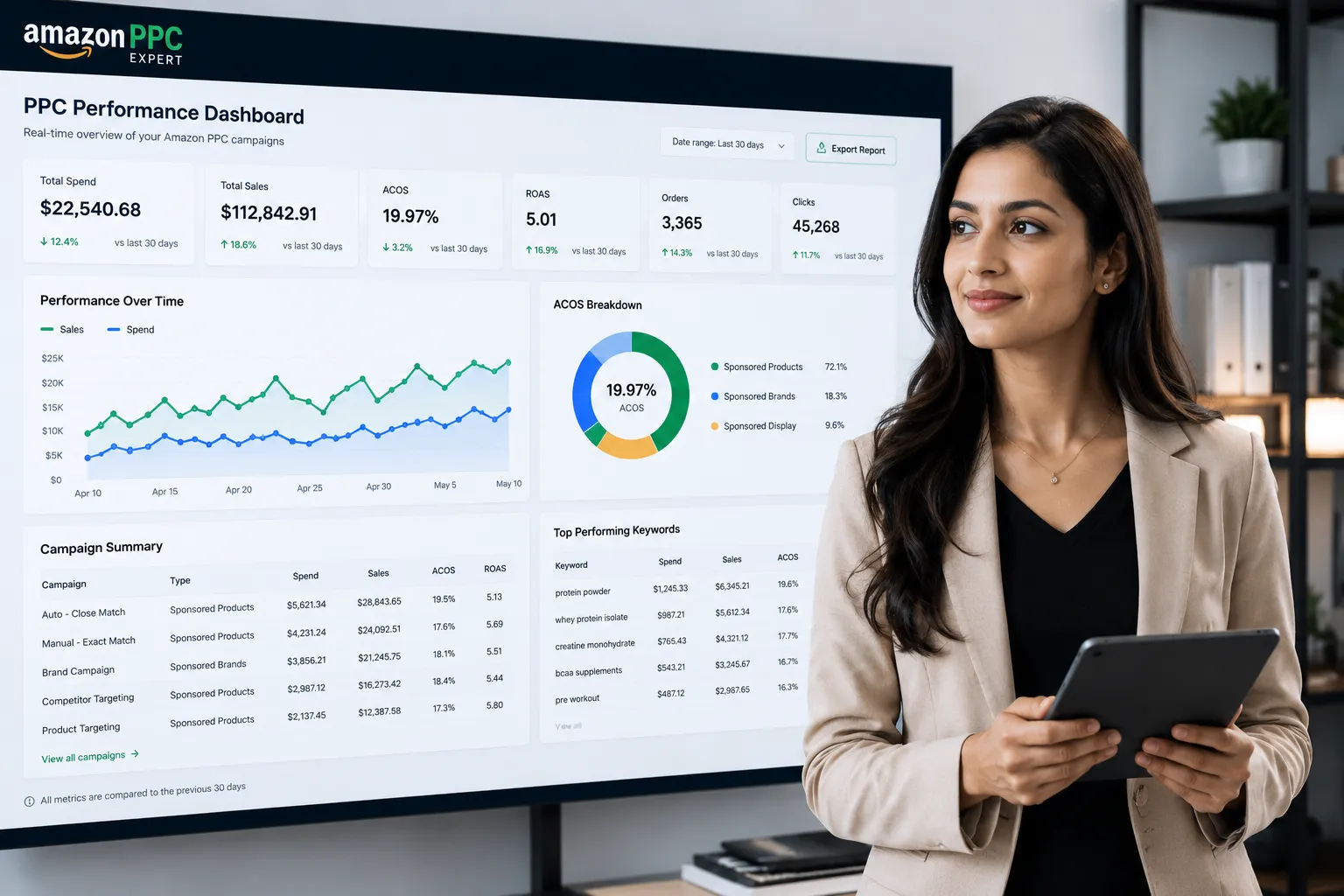
A clear, repeatable process, adapted to your products, category and marketplaces. No two accounts follow it in exactly the same order, but every account goes through each stage.
We start with your business, not your campaigns. Which products matter most? What are their margins? How much stock do you have, and when does more arrive? Are you aiming for profit now, growth in rank, or a balance of both? Are there seasonal peaks or launches coming?
These answers shape everything that follows. Advertising a product that is about to run out of stock, or pushing a low-margin item at the same ACoS as a high-margin one, are expensive mistakes that no amount of bid tuning can fix.
Next, we audit your Amazon Ads account in detail. We look at campaign structure, targeting, match types, search terms, negatives, placements, bidding strategies, budgets and spend by product. We separate branded from non-branded performance so you can see what your advertising is really doing.
You receive a clear summary of what’s working, where money is being wasted and what we’d change first, in plain language rather than a data dump.
We study search demand, competing listings, typical CPCs and seasonality for your category and marketplace. We look at who advertises on your branded terms and product pages, and where competitors are weak. This keeps targets and budgets realistic from the start.
We agree goals with you product by product: target ACoS, overall TACoS, budget levels and priorities. Launch products, core bestsellers and long-tail items each get a different approach.
We build new campaigns or restructure existing ones by intent and match type, carrying proven keywords across so you keep the learning your account has already paid for. Naming conventions are applied so reports stay easy to read.
The first few weeks after launch or restructure are about gathering clean data. We monitor spend, impressions, clicks and early conversions closely, fixing obvious problems quickly while avoiding hasty cuts. Sponsored Products sales are credited over a 7-day window for sellers (14 days for vendors), and Sponsored Brands and Display over 14 days, so we judge keywords on complete data.
Once campaigns settle, we move into a regular cycle: search term harvesting, negatives, bid changes, budget moves and placement adjustments, alongside tests of new keywords, product targets, ad types and creative. Spend is scaled only where results prove it pays.
Regular reports show what changed and why, and review calls let us adjust strategy as your catalogue, stock, pricing and goals change. You keep full access to your account throughout.
Amazon Ads reports contain dozens of numbers. These are the ones that tell you whether advertising is working, and how we read each one.
| Metric | What It Measures | How We Use It |
|---|---|---|
| ACoS | Ad spend ÷ ad-attributed sales | Judged against each product's break-even ACoS, never in isolation. |
| Break-even ACoS | Profit margin before advertising | The ceiling for profitable advertising on a product. |
| TACoS | Ad spend ÷ total sales (ad + organic) | Shows whether advertising is growing the whole business. |
| ROAS | Ad sales ÷ ad spend | The inverse of ACoS; useful when comparing Amazon with other channels. |
| CPC | Average cost per click | Tracked by keyword and placement to spot rising competition. |
| CTR | Clicks ÷ impressions | Signals whether the main image, title, price and reviews win attention. |
| CVR | Orders ÷ clicks | Low CVR usually points to a listing or price problem, not a bid problem. |
| Impression Share | How much available demand you reach | Shows room to grow on proven terms. |
Both can work. The right choice depends on your time, your team’s experience and how much ad spend is at stake.
| In-house | Specialist Amazon PPC Agency | |
|---|---|---|
| Time | Competes with every other job in the business | Dedicated time every week |
| Experience | Built on your own budget, one account at a time | Built across many accounts, categories and marketplaces |
| Cost | Salary, training and your own hours | A management fee, with no hiring or training cost |
| Control | Full | Full: you keep account access and approve strategy |
| Fresh Perspective | Hard to spot your own blind spots | An outside view of structure and waste |
| Best For | Small catalogues and modest budgets | Growing catalogues, multiple marketplaces, rising spend |
Many sellers start in-house and switch when the account outgrows the time they can give it. The signs are usually rising spend with flat total sales, a structure no one fully understands any more, or expansion into new marketplaces.
Outsourcing your Amazon PPC gives you a specialist team without adding headcount. You keep ownership of your account, your data and your strategy; we handle the weekly work of running it well.
What outsourced management gives you:
Not every business needs full management. If you have an in-house marketer or team, we can work as your Amazon PPC consultant instead.
Consulting support can include:
When every pound or dollar matters, focus is everything. We concentrate spend on high-intent keywords and proven products, cut waste early and scale only when campaigns prove profitable. Smaller brands can compete in crowded categories by winning specific, high-converting searches rather than chasing broad, expensive ones.
For brands with larger catalogues and Brand Registry, the challenge shifts from getting clicks to protecting margin and market share. We defend branded search and product pages, manage TACoS across product lines and use Sponsored Brands and Display to grow the whole range, not just a few heroes.
Vendors face different reporting, a longer attribution window and less direct control over pricing and stock. We plan advertising around those realities, with clear reporting your buying and marketing teams can use.
A launch needs visibility, early sales and clean data. We build launch campaigns that balance spend against the long-term value of reviews and organic rank, with a clear plan to bring ACoS down as conversion improves. Our listing optimisation service makes sure the listing is ready before traffic arrives.
We can take over Amazon advertising entirely, or work alongside your team as consultants, so your marketers can focus on the wider plan.
Competing with larger brands on Amazon can feel impossible when they outspend you on every broad keyword. You don’t need to beat them everywhere. You need to win the searches that matter most for your products.
Our approach for smaller sellers:

Amazon PPC management pricing depends on the work involved. The main factors are:
Agencies usually charge a fixed monthly fee, a percentage of ad spend, or a mix of both. [CONFIRM: describe your model, e.g. “We charge a fixed monthly fee based on scope, with no long-term lock-in.”]
The more useful question is what management returns. Cutting wasted spend, improving TACoS and growing profitable sales should more than cover the cost. If it doesn’t, the management isn’t working.
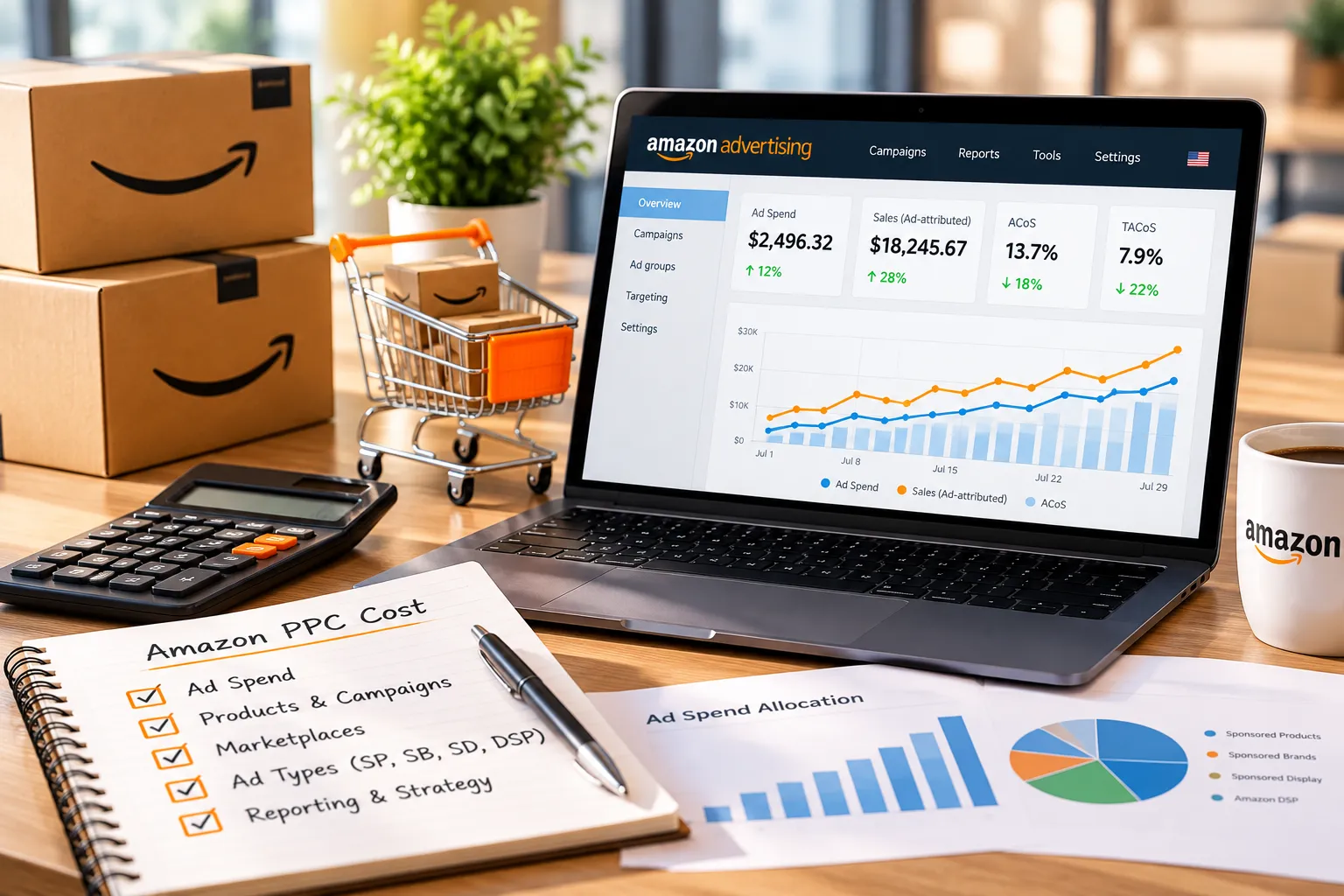
It is the ongoing planning, building, monitoring and optimisation of advertising on Amazon, including Sponsored Products, Sponsored Brands, Sponsored Display and sometimes Amazon DSP. Good management focuses on profitable sales and total business growth, not just clicks.
Typically an audit, profit targets, campaign structure, keyword and product targeting research, bid and budget management, search term harvesting, negative keywords, placement optimisation, Sponsored Brands and Display management, competitor monitoring and regular reporting.
It depends on ad spend, catalogue size, marketplaces, ad types and support level. Agencies usually charge a fixed fee, a percentage of ad spend or a mix. [CONFIRM: your pricing model.] Contact us for a tailored quote.
Amazon PPC is paid: you bid for ad placements and pay per click. Amazon SEO is organic: it improves how your listings rank without paying for each visit. They work best together, because ad sales can support organic rank and a well-optimised listing lowers ad costs. See our Amazon SEO service.
There is no universal figure. A good ACoS sits below your break-even ACoS, which equals your profit margin before advertising. A product with a 40% margin breaks even at 40% ACoS, so a 30% target leaves profit.
ACoS compares ad spend with ad-attributed sales. TACoS compares ad spend with total sales, including organic. TACoS shows whether advertising is lifting the whole business.
Wasted spend can often be reduced within the first few weeks. Restructuring and scaling usually take a few months, because new campaigns need data and Amazon credits sales to ads over a 7- or 14-day window.
No. Smaller budgets work when focused on high-intent keywords and proven products. The budget must be large enough to gather useful data, then grow as campaigns prove profitable.
Usually both. Automatic campaigns find search terms you might miss. Manual campaigns give control over keywords, match types and bids. Proven terms from auto campaigns move into manual exact-match campaigns.
Sponsored Products promote a single listing in search and on product pages. Sponsored Brands show your logo, a headline and several products or a video, and require Brand Registry. Most accounts start with Sponsored Products and add Sponsored Brands once the brand is registered.
Not for Sponsored Products. Sponsored Brands, Sponsored Brands Video and Amazon Stores require Brand Registry, and it unlocks more Sponsored Display options, so most growing brands benefit from enrolling.
Most active accounts benefit from weekly reviews of bids, budgets and search terms, monthly reviews of placements and targeting, and quarterly reviews of structure and goals.
Yes. We manage campaigns across international Amazon marketplaces and plan keywords, bids and budgets for each one separately. [CONFIRM: marketplaces currently managed.]
Yes. We manage advertising for third-party sellers on Seller Central and for brands and manufacturers on Vendor Central.
Always. We work through user access you grant and control. You never share your password and can remove our access at any time.
We use tools for bulk changes and reporting, but experienced specialists make the decisions on bids, search terms, negatives and budgets. Automated rules left unchecked can waste spend quickly.
It often helps. Ad-driven sales add to a product's sales history on relevant searches, which can support organic visibility over time. Results vary by category, so we track organic and total sales, not just ad sales.
Yes. We can manage everything, or act as an Amazon PPC consultant, auditing, setting strategy and training your team while they run day-to-day changes.
Yes . We review your campaign structure, search terms, targeting, placements and spend by product, then show you where money is being wasted and what we'd change first. You keep the findings whether you work with us or not.
We start from your goals and each product's break-even ACoS, then look at search demand, typical CPCs in your category and how much data campaigns need to learn. Budgets begin at a level that produces useful data and grow as campaigns prove profitable.
It works in most categories, but results vary with competition, CPC levels, margins and how well listings convert. Some categories also have advertising restrictions. An audit shows what is realistic for your products.
Amazon doesn't publish one. But relevance clearly matters: ads for products that match the search and convert well tend to win placements more efficiently. Strong listings, accurate targeting and good conversion rates all help lower your effective cost per sale.
You'll receive regular reports on spend, sales, ACoS, TACoS and ROAS by product and campaign, with plain-language notes on what changed and why. You also keep full access to your Amazon Ads account, so you can check performance any time.
Amazon PPC is our core focus rather than one service among many. We set targets from your margins, manage to TACoS as well as ACoS, keep decisions with experienced people rather than automated rules, and report openly on what we changed and why.
No. Results depend on product, price, reviews, stock, competition and marketplace, so no honest agency can guarantee a specific ACoS, ROAS or sales figure. We commit to experienced management, clear reporting and continuous optimisation.